



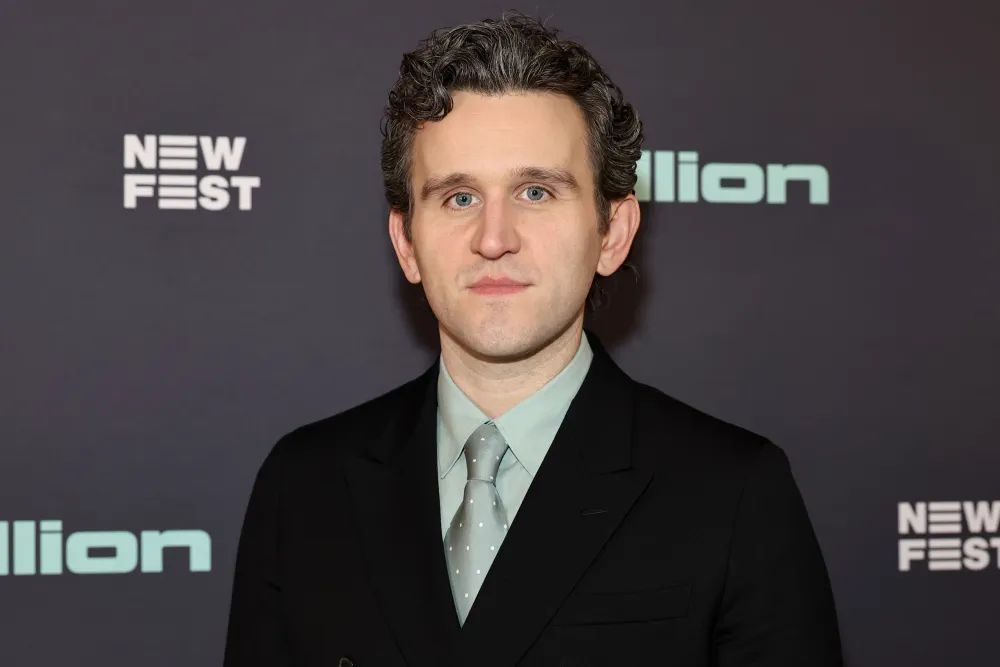
According To The variety For the BDSM drama “Pillion,” Harry Melling traded the world of wizarding for one of leather, licking boots and orgies in the wilderness.
Best known for playing Dudley Dursley in the “Harry Potter” films, the actor, now 36, takes on his first true leading role in Harry Lighton’s unorthodox romance. In the film, Melling plays Colin, a shy meter maid and barbershop quartet singer who catches the attention of Ray (Alexander Skarsgård), a stoic motorcyclist looking for a “sub” to fulfill his sexual (and domestic) desires.
oon, Colin is cooking meals and doing chores for Ray. They don’t kiss, and Ray makes him sleep on the floor by the bed like a dog. It might sound degrading, but when Colin appears midway through the movie in a leather biking outfit and shaved head, he looks liberated. Below, Melling talks to Variety about the year’s kinkiest rom-com, getting comfortable with Skarsgård and why he has never consciously tried to escape the long shadow of Hogwarts.
Did you have any hesitations when you first read the script?
I kind of went in with no fear, to be honest. I think I would have been nervous if the sex scenes — or the more risky, out-there moments — weren’t grounded in the storytelling. If they’d just been interludes meant to be sexy, I think I would have felt quite nervous about that.
But when I read the script, I always felt those scenes were genuinely pushing the narrative forward. They tell the story very intricately — Colin’s journey from inexperience to experience — and because they were so embedded in the narrative, they felt like a continuation of the acting process rather than a moment designed to create a “beautiful love scene,” if you know what I mean.
What do you make of the studies that say Gen Z rejects sex scenes?
With a movie like “Pillion,” if you take the sex out of it, you don’t have a movie. The sex, the expression of it and the way it helps build the characters and their stories is so pivotal to the DNA of the film. I can’t really comment on the idea of a younger generation rejecting sex scenes. I’m 36 now, and in my experience of going to the movies, sex has always featured in some way. Maybe the question is more about how sex is being portrayed — perhaps that’s what’s shifting. I haven’t seen “Heated Rivalry” yet, but obviously in the states it has blown up. Maybe there’s something about sex being articulated in a different way now than it was before.
When you choose roles, is there an appeal to go for projects that feel dangerous and exciting in order to shed the “Harry Potter” thing?
It’s never been something I’ve thought about directly. I’ve never said to myself, This is a good decision because it pushes me further away from how people might have seen me when I was younger. That’s not really how I operate. In fact, when I try to think strategically, it always backfires in some way.
What I am looking for is variety. I’m always looking for new challenges and for as rich and varied a career as I can possibly have. And I know this sounds strange, but I’ve felt that way since I was about 10 years old, when I started doing the “Potter” films. Trying to deliberately maneuver away from “Harry Potter” would probably hinder me, because I’d be too aware of what I’m coming from. It’s far better to live in a kind of ignorance and just follow your nose — to pursue the work that genuinely excites you.
You and Alexander Skarsgård met only a couple of days before filming. How did you build trust in each other?
I had done a week of filming prior to when Alex flew in. We met on a Saturday, and on Sunday we rehearsed the wrestling scene. We basically jumped on each other and worked that out, into the intimate scene. Then on Monday, we started shooting. It really was: “bish, bash, bosh — here we go.”
For my character especially, it was kind of incredible for that reason. Colin is always second-guessing Ray’s behavior — how do I please this man? What does he want? Am I in the right place? All of those thoughts are constantly running through his head. The fact that we hadn’t had months beforehand to sit down and talk through how we’d play the roles or what backstories we’d each imagined was actually really useful. It meant that what we were discovering happened in real time, on set, in front of the camera. It was a happy accident — not by design at all, just a logistical necessity because Alex was away — but it worked in our favor.
We also worked with an incredible intimacy coordinator, Robbie Taylor Hunt, who was instrumental in shaping those scenes. In many ways, his role is like that of a stunt director. It’s about camera placement, angles, physical positioning — the practical details that help sell a moment on screen — but also about protecting the narrative beats of the story. He was pivotal in making sure those scenes served the characters and the arc.
It’s funny to hear about how some of the sexiest scenes are filmed in very unsexy ways.
Oh, big time. If you saw some of the outtakes from the alleyway scene, where I’m giving Alex a blowjob, I was completely at the wrong angle. It looked hilarious. Hopefully, in the edit, the thrill of it comes across. But in the doing of it, it’s often just about nailing those small adjustments and technical details that help sell the sex of it.
Some of the sex scenes are quite funny and elicit laughs, but the movie doesn’t mock the sexual subculture. How did you straddle that line between shock value and respect?
A huge part of doing that was working with the GBMCC — the Gay Bikers Motorcycle Club. They’re a real organization, and they were in the film, playing the pillions and bikers, but they were also central to our research. They introduced me to people in the kink scene who taught me about things like bootlicking. They were a pivotal part of making the film feel authentic. A lot of them came to Cannes when the film premiered, and they seemed genuinely thrilled with the film. That was such an important thing, that they felt their story was represented on screen.
One of the things I enjoyed about the film is that Colin’s parents are incredibly supportive of him and set him up on dates with men. But they feel, justifiably, protective and slightly uncomfortable with his dynamic with Ray.
The parents’ journey in the film is almost the opposite of the norm. They start from a place of absolute acceptance. They’re almost overly supportive, suffocating Colin in certain ways — “Have you got a boyfriend yet?” and all of that. As the story progresses and they begin to understand — or not understand — Ray and the nature of the relationship, they shift. They don’t deny the relationship, but they challenge it.
The Sunday dinner scene was always one of the most important in the script for me, because it’s where all the perspectives coexist in one space. You’ve got Peggy, who’s deeply questioning the relationship and who Ray is and what his intentions are. You’ve got the dad trying to stay in the middle, keeping the peace. And then you’ve got Ray saying, “It’s a consensual relationship. Colin knows what this is. This is how it works. What’s the problem?”
It’s been fascinating talking to audiences in Q&As, because that’s the scene where people really divide. Some are firmly on Team Peggy; others are on Team Ray, asking what Peggy’s problem is — they’re happy, it’s working. For Colin, that confrontation becomes the catalyst for the final act. It’s the moment that pushes him to question the dynamic Ray has established and say, “Actually, I think I need more. I want more from this relationship.”
When the relationship ends, Colin has developed a sense of what he wants and the ability to express that. Have you had similar moments in your career, of coming out of a project with newfound knowledge about yourself?
Sometimes there are things that linger; characteristics that hover and stay with you for a while after you finish. “Pillion” was the first film where I’m in nearly every scene and every shot, which is a very different beast for me. What stayed with me was Colin’s optimism and his curiosity — those are the things that really lingered. I felt like a much more receptive human being for a long while, because I was still in Colin’s pursuit of understanding, his wanting to put himself together. When I finished playing Edgar Allan Poe in “The Pale Blue Eye,” it had a different kind of after-effect — a quite sad one, given the ending of that film. Every movie is somewhat different in terms of the place it leaves you.
What feedback have you gotten so far on “Pillion”? Have you talked to people in sub/Dom relationships?
A lot of the Q&As we’ve been doing, particularly in the U.K., have been fascinating. We spoke to one woman after a screening who was really interested in talking about consent — about how in some relationships, a contract is drawn up to establish the rules, and how that didn’t happen in “Pillion.” It’s interesting, because there are just so many different versions of how these relationships can work. A lot of people come up to me and say, “I understand Colin” or “I felt like I was Colin” — and that, to me, is really moving, that they feel they can share that with me




+ There are no comments
Add yours