




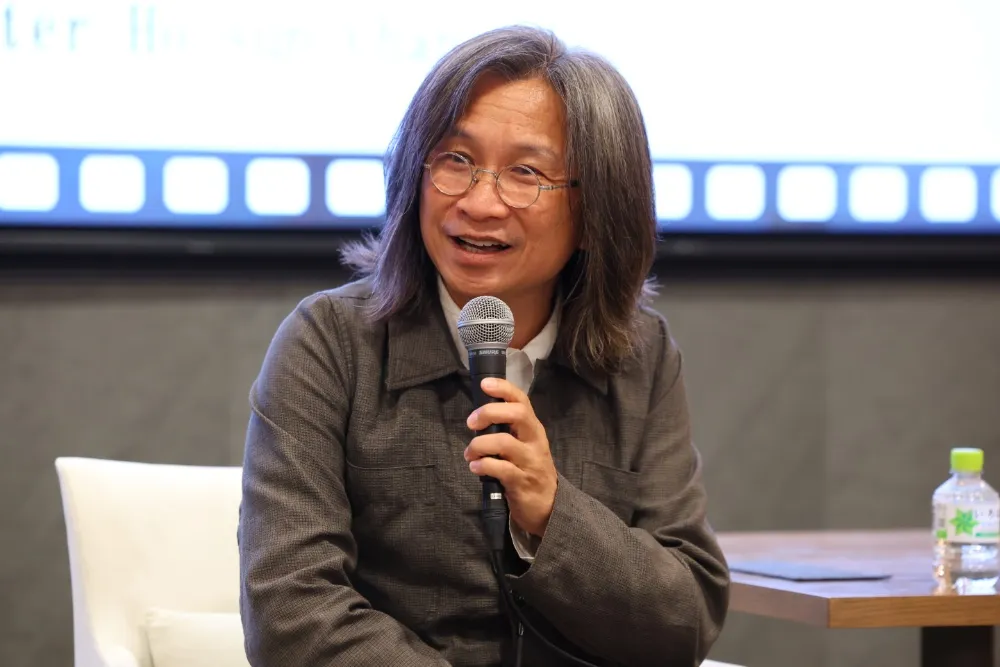
According To The variety Filmmaker Peter Chan Ho-sun returned to the Tokyo International Film Festival nearly three decades after his UFO (United Filmmakers Organization) films packed the city’s theaters, reflecting on a career shaped by market forces from Hong Kong’s golden age through Hollywood detours to his current work in mainland China.
Speaking at the festival where his 1993 film “He Ain’t Heavy, He’s My Father” and 1994’s “He’s a Woman, She’s a Man” once drew overflow crowds to Shibuya venues, Chan traced his journey from independent-minded Hong Kong filmmaker to major Chinese productions, explaining how economic realities have dictated every creative turn.
“Those were the best days of my life. No matter what I went on to do in the future, I remember those days where they were the best days,” Chan said of his UFO period, when he received a gift of videotaped footage from the 1994 festival showing him with fellow UFO directors Jacob Cheung, Tony Leung Ka-fai and Carina Lau at the old venue. “Those were the best days of my life. No matter what I went on to do in the future, I remember those days where they were the best days,” Chan said of his UFO period, when he received a gift of videotaped footage from the 1994 festival showing him with fellow UFO directors Jacob Cheung, Tony Leung Ka-fai and Carina Lau at the old venue. He contrasted that with Hong Kong’s freewheeling methods: “Back then in Hong Kong, those were the best days of our lives, because if we come up with that idea, we go write the treatment, basically, we start making a movie. And we would be done in five weeks, six weeks, like ‘He’s a Woman, She’s a Man’ was done in five weeks, and it wrapped five days before the showing, the release date. It’s crazy, but that’s how we work, how we used to work.”
Returning to Asia, Chan pioneered pan-Asian co-productions through his company Applause Pictures, leveraging his Thai-Chinese-Hong Kong heritage. He produced films with Thai director Nonzee Nimibutr, Korean filmmaker Hur Jin-ho, and collaborated with Kim Jee-woon and Nimibutr on the horror anthology “Three.” “We did the ultimate co-production back then,” Chan said of the 2002 project.
He directed his own segment for “Three,” making what he calls “a love story with a scary film massage in disguise” since he didn’t know how to make horror films. “The things that actually cross borders and would work business wise, were always horror. So I said, you know, I can’t make a career for the rest of my life out of making or producing horror movies I want to direct, and I can’t keep directing horror film.”
That realization led Chan to make his first mainland Chinese film, the 2005 musical “Perhaps Love” starring Takeshi Kaneshiro, Jacky Cheung and Zhou Xun with Bollywood choreographer Farah Khan.
From there, Chan moved into large-scale Chinese productions, always adapting to market demands. “I make movies that the market needs. Because if the market don’t need that movie, you can’t get funding, you can’t get investment, and you can’t get to make the movie. So I make whatever movie that the market needs at the moment,” he explained.
“The Warlords” followed because period epics were what Chinese audiences wanted in 2007, though Chan’s version featured minimal action despite starring Jet Li. “Out of two hours and 15 minutes, it was about 15 or 20 minutes of action. And they’re not Jet Li’s kind of action. They’re like war action, which is not really kung fu action and it’s really a drama. It’s really not a real action movie.” He followed that with “Wu Xia” featuring Donnie Yen, crediting Yen and action director Kenji Tanigaki for the fight choreography while he focused on character and drama.
The success of 2013’s “American Dreams in China” gave Chan the confidence to make 2014’s structurally unconventional “Dearest,” about child abduction told from opposing perspectives. “Many people say ‘Dearest’ feels disjointed, structurally inconsistent. But that was intentional. The first half follows one perspective; the second half switches to its opposite. It might be the least ‘commercial’ film I’ve ever made. But again, that confidence came from the previous success.”
Working in China has made it financially impossible to return to Hong Kong production. “The budget has become higher and bigger in China, and it also pumped up the price of your crew, because a lot of big movies in China back then, they were all Hong Kong. And the Hong Kong cruise, the big market in China has pumped up the price of cruise in Hong Kong who worked in China. And when you want to go back to work in Hong Kong, Hong Kong can’t afford that. So it’s very difficult to go back to work in Hong Kong.”
Chan’s latest film “She Has No Name,” which premiered at Cannes 2024 and opened the Shanghai International Film Festival this year, screened at Tokyo as part one of a two-part story about a 1945 Shanghai murder case. Based on one of China’s most famous unsolved murder cases, the film centers on Zhan-Zhou (Zhang Ziyi), a wife charged with the bloody dismemberment of her husband during the Japanese occupation of Shanghai in the 1940s – a killing that seems impossible for her to have committed alone.
The second part, expected to release next year, contains extensive backstory about the marriage’s deterioration. “There’s a whole chunk about the relationship between the husband and her, and how the marriage turned sour, and how it became violent, how he became a violent wife beater, and how she finally decided that she had to kill him.”
Reflecting on which of his films endures most with audiences, Chan noted that “Comrades: Almost a Love Story” remains the one 80% of people mention, though it’s “not the most difficult movie to me, and that’s not the most pleasant experience either, and that’s not even the most personal movie for me.” He attributes its lasting impact to timing. “For some movies, just everything just was just right at the time or at the moment.”
Chan was in conversation with TIFF programming director Ichiyama Shozo






+ There are no comments
Add yours